Click here to listen to this sermon.
And God said to [Solomon], “Because you have asked this, and have not asked for yourself long life or riches or the life of your enemies, but have asked for yourself understanding to discern what is right, behold, I now do according to your word. Behold, I give you a wise and discerning mind, so that none like you has been before you and none like you shall arise after you. I give you also what you have not asked, both riches and honor, so that no other king shall compare with you, all your days. And if you will walk in My ways, keeping My statutes and My commandments, as your father David walked, then I will lengthen your days” (1 Kings 3:11-14).
Grace to you and peace from God our Father and the Lord Jesus Christ!
Did ever a ruler’s reign begin with so much hope and with so much promise? Solomon, the successor to his father David’s throne, truly loved the Lord. He walked in faithfulness and was upright in heart. He was a man of many talents and recognized that those talents, including that of leadership, were gifts from God.
And so, it happened that while Solomon was sleeping, the Lord Himself appeared to him in a dream, saying, “Ask what I shall give you” (v 5). It appears that the Lord was so pleased with Solomon that He wanted to give him an inaugural gift, something to celebrate Solomon’s coronation as king.
Now, there’s a great opportunity—one, I suppose, that any one of us would enjoy. It reminds me of the story of the fellow who rubs the magic lamp and is granted three wishes. Only this was the real deal.
What would you choose? Perhaps, if I were a new king, I’d pray for a long reign. Maybe, I’d ask to preside over a nation that grew in power and wealth. Maybe I’d petition for a large and efficient military to defend the borders of the land. Or, just for fun, I’d ask for a big palace, with swimming pools and a spa.
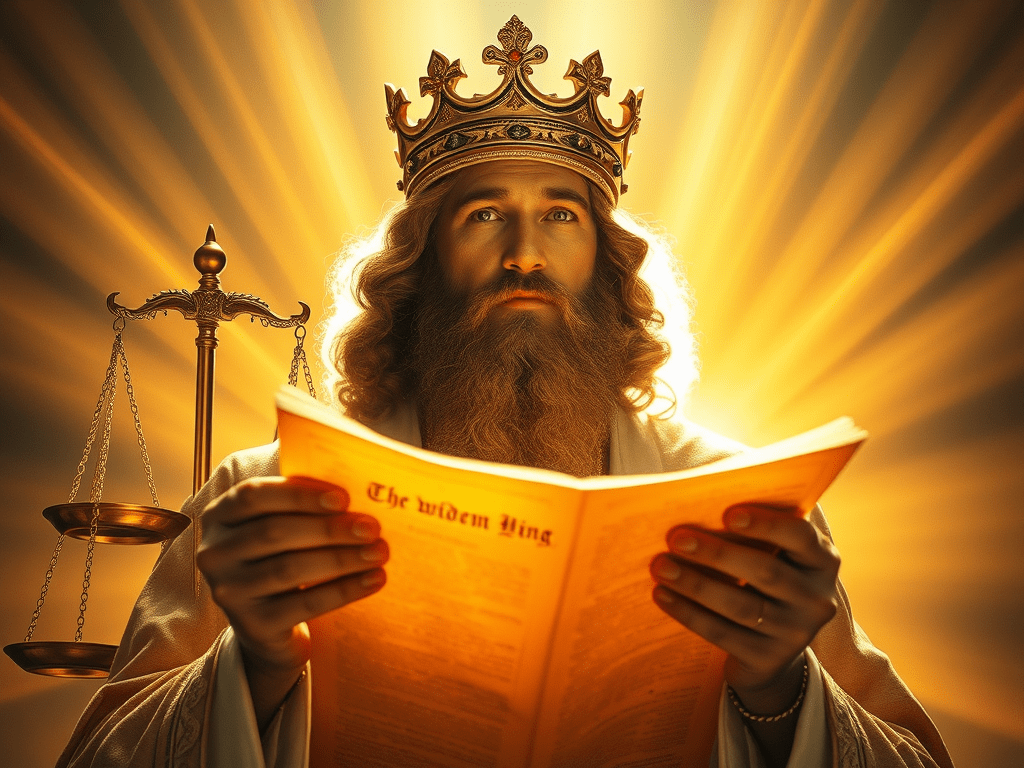
But Solomon asked for none of these earthly things. Instead, he sought wisdom. He sought the power to discern between right and wrong, that he might rule his people fairly, in a way that would benefit his people and please his God.
And so, our Lord granted to Solomon wisdom, for which he became famous, even to this day. From all corners of the earth, people came to hear and learn from Solomon, who knew how to apply that wisdom in real-life situations. Even the famous queen of Sheba traveled to hear him and lay treasures at his feet. And no one who came to Solomon was disappointed, for he had a way of seeing clearly to the right solution. Think, for instance, of the two women who came to Solomon, each claiming to be the mother of a certain child. Solomon in his wisdom decreed that the baby should be cut in two, knowing that the real mother would never agree to such a plan. Think also of the Book of Proverbs, which so beautifully encapsulates Solomon’s wisdom, giving practical advice to young people, especially as they think about the lives they have before them.
But, as we know, Solomon’s story didn’t end as well as it began. Before long, ironically, the prince of wisdom, became the king of fools. What happened? Well, along with wisdom, our Lord gave Solomon great wealth and honor. Maybe these earthly honors were his downfall. Maybe the money and power went to his head. Maybe it was women?
In his desire to enlarge the kingdom and promote diplomacy, Solomon took to himself many wives who believed in many false gods. And the heart of Solomon turned, and he began to forget the God who loved him. And the great King who built the Lord’s temple, also built temples to the pagan deities, including Ashtoreth the goddess of the Sidonians and Milcom the abomination of the Ammonites. The very same Solomon whose wisdom saved a child and put that child with its rightful mother was now building temples where children were sacrificed to pagan gods. Oh, how the mighty fall, and the greatness of wisdom turns to folly.
Solomon, who rose to the pinnacle of wisdom, fell to the absolute depths of folly, just another foolish and corrupt leader. This was not what Israel needed. Israel needed a new king, a better Son of David, one who would reign with wisdom and establish a kingdom that would not fall. Israel needed not only a wise king, but a king who could save his people from their own self-destructive folly.
The Lord had told Solomon: “I give you a wise and discerning mind, so that none like you has been before you and none like you shall arise after you.” Although he was far from perfect, Solomon and his wisdom was the “perfect” type, or foreshadowing, of Jesus’ wisdom. His guiding God’s great people of the Old Testament has continued to enlighten every age since through his writings (Proverbs, Ecclesiastes, Song of Songs). But his story is especially enlightening in reminding us that no human wisdom, even Solomon’s renowned wisdom, has lasting value without the Word, Wisdom, Wisdom Incarnate.
And so, we come to our Gospel for today, where we are introduced to the true Son of David, born in Bethlehem, the city of David. And we are introduced to Him when He was yet a child, and we are told by the evangelist Luke that this “child grew and became strong, filled with wisdom. And the favor of God was upon Him” (Luke 2:40).
This boy appeared to be filled with wisdom beyond His years. You remember the story. Jesus’ parents were returning home from Jerusalem when it dawned on them that they hadn’t seen Jesus all day. Naturally, they were worried and hurried back to the city. And where did they find the boy Jesus? He was in the temple with the great teachers, listening to them and asking questions. “And all who heard Him were amazed at His understanding and His answers” (Luke 2:47).
Now, here was hope and here was wisdom. And Luke tells us that Jesus, the twelve-year-old lad, “increased in wisdom and stature and in favor with God and man” (Luke 2:52).
And now we are dealing with a mystery. Jesus, as a boy, grows in wisdom and stature. And yet, He Himself is the Wisdom from on high. He Himself is the eternal Wisdom through whom the world was made.
And how did Jesus exhibit that wisdom? He did so in His preaching. I think, for instance, of the Sermon on the Mount, where Jesus would open His mouth like an oracle, imparting wisdom from on high. And what did His wisdom consist? The wisdom of Ecclesiastes. The wisdom that was imparted to Solomon only after a lifetime of seeking pleasure and power. A life that comes with experience and learning from your mistakes.
Solomon, later in his life, offered this message of hard-won wisdom, the kind of wisdom that can’t be given all at once. He said, “Vanity of vanities… all is vanity” (Ecclesiastes 1:2). Yes, Solomon was given wisdom by God, but it wasn’t given all at once. He had to learn the hard way that his focus had been misdirected. That us to say, everything that the world considers important, isn’t. As my first boss, Ralph Korn used to say, “We grow soon too old, too late schmart.”
Kingdoms rise and fall, as do kings. Wealth comes and goes. You can’t take it with you. The wise man dies just the same as the fool. We are mortal creatures, and having come from the dust, to the dust we will return. Wealth is fleeting and honor is temporary. Try to make a name for yourself if you’d like, but the next generation will forget you. Death, the great equalizer, finally takes both prince and pauper. The only thing that matters, ultimately, is the fear of the Lord, the trust in God, who alone can save.
Jesus came and offered His Sermon on the Mount, saying, “Do not lay up for yourselves treasures on earth, where moth and rust destroy and where thieves break in and steal.” And again, “Do not be anxious about your life, what you will eat or what you will drink, nor about your body, what you will put on. Is not life more than food, and the body more than clothing?” (Matthew 6:19, 25).
You see, our Lord Himself offers the true and final wisdom that Solomon sought. Seek first the kingdom of God and His righteousness. Then all the other stuff will be added in the life to come. Seek the heavenly treasure; and what is the wisdom? Perhaps, instead, we should ask “Who?” For the Lord Himself is our treasure, and He is our wisdom. The Lord Jesus is the true Son of David, who by the folly of the cross has saved us from our own foolish ways.
Yes, the world is foolish. So caught up in things that won’t last, in goals that have no enduring value. You want money? It won’t make you happy, and when you die, relatives and lawyers will circle to get their “fair” share. You want to live a long life? Well, you can only live so long. You want to make a name for yourself and become famous? Some day, even Mount Rushmore will crumble. That’s the nature of things.
But our Lord offers us a kingdom that is better than the one Solomon himself ruled. For the kingdom of God, which comes through the preaching of the Gospel, will never fade or fall. The devil himself, within all his fury, won’t be able to prevail against it. The kingdom that Christ proclaims is from everlasting to everlasting. Wealth gives pleasure for a while, but the kingdom of Christ brings eternal joy and takes away all our fears, even the fear of death.
The world in its foolishness says that the cross is a sign of weakness, a picture of shame. The world wants a king dressed like Solomon of old; it mocks a ruler whose throne is the cross and whose crown is made of thorns. Yes, the world is filled with foolish scoffers, those who think they’re so smart. The world is littered with men who look in the mirror and are impressed by their own wisdom.
But the folly of the cross is greater than the wisdom of men, for in that cross of shame alone do we find all glory and honor, and in that death, we find our life.
Oh, how often have we, like Solomon, been led astray? How often have we forgotten the wisdom that so many of us learned from our parents? Today, once more, we are reminded that the fear of the Lord is the beginning of wisdom. And so, we do well to hear the Word of Wisdom. Make the most of your time here. Work hard, but then use your treasure wisely, for the sake of the kingdom, for the proclamation of the Gospel. Money comes and goes, but the Word of the Lord remains forever. And the Gospel alone is the Word of eternal life.
Thanks be to God, who gave us His Son, the Son of David. Thanks be to Christ, the Good King, True Wisdom, who in foolish love died that we might live, who paid the price for our folly that we might live forever in His kingdom. Amen
Unless otherwise indicated, all Scripture quotations are from the Holy Bible, English Standard Version, copyright © 2001 by Crossway Bibles, a publishing ministry of Good News Publishers. Used by permission. All rights reserved.


 St. John's Lutheran Church - Britton, SD
Leave a comment